Who We Are

Our Mission: Seek Understanding. Share Knowledge. Act for Nature.

Our Approach

Nature Squamish is powered by citizen science and our commitment to help conserve wildlife habitat, safeguard vulnerable species, and provide opportunities for members and the public to appreciate and learn about nature. Our guiding principles are to:

Seek Understanding

Our field-based studies gather data about vulnerable species and the health of supporting wildland habitat and connectivity networks. Our stewardship activities and educational programs provide opportunities for people to learn and connect with nature.

Share Knowledge

We share our findings with community members and conservation organizations to build knowledge, to learn from others, and to direct our common conservation goals.

Act for Nature

We support land managers in taking actions to protect vulnerable species, and to safeguard ecosystem health and connectivity.

About Us

Nature Squamish is a volunteer-run community organization that brings people together to learn about, appreciate and protect local wildlife and habitats. Our work combines field-based research, education, stewardship and collaboration with local and regional partners.

As Squamish grows, we help ensure that biodiversity conservation and environmental planning are woven into the fabric of our community.
Placeholder Image

Where We Operate:

Nature Squamish is based in Squamish, British Columbia, at the head of Howe Sound. Our work focuses on the Squamish River watershed and upper Howe Sound.
Placeholder Image

Our People

Our work is driven by a dedicated group of volunteers who collectively offer a voice for nature.

Meet Our Directors

Image

Rachel Shephard

Curious life-learner, passionate about nature and inspiring stewardship.
Image

Murray Journeay

Geologist using landscape modeling to support biodiversity conservation.
Image

Gwen L’Hirondelle

Biodiversity Squamish contributor capturing pollinators and bryophytes through my lens.
Image

Carl Halvorson

Hatched in Squamish, dedicated to public engagement and conservation.
Image

Niall Bell

Passionate wildlife photographer and conservationist working to share and protect wildlife.
Image

Claudia Cridge

Conservation researcher and keen wildlife nerd.

Our Members

We are grateful for the ongoing support and participation of our members, whose involvement helps guide our organization and strengthens our collective voice for nature.

Our affiliation with BC Nature  connects us with more than 7,000 members from over 65 Nature Clubs/Organizations working together in vital stewardship efforts across BC.

New Nature Squamish memberships are welcome at any time of year.

Join Us
Placeholder Image
Placeholder Image

Our Volunteers

Nature Squamish is powered by volunteers at every level, from our board of directors to program coordinators and participants.

We rely on their dedication and expertise to carry out our work and we warmly welcome anyone who wants to get involved, share their skills, and make a lasting impact.

Join Us

Our History

How We Got Here
Learn about key milestones in the history of our organization. Please contact us if you have additional pieces of our story to contribute.

1972-1982 A Proposed Coal Port

In 1972, a 5km training dyke was built along the western channel of the Squamish estuary, to support a BC Rail proposal for a deep sea port and coal terminal. The dyke redirected the Squamish River to the west bank, cutting off flow to other channels and blocking juvenile salmon from protected habitat.

The west and central channels were dredged, removing natural sediments and 150,000 truck loads of material were loaded onto the Central Delta. The proposed development threatened the remaining functional fish and wildlife habitats of the estuary.

The provincial government initiated an estuary management planning process, resulting in the 1982 Squamish Estuary Management Plan (SEMP).

1982-1992 Gathering Data, Raising Awareness

Our society was founded as the Squamish Estuary Conservation Society (SECS) in response to these development pressures. SECS members were concerned about the proposed balance between protecting biological productivity and allowing development.

Over the following decade, members raised awareness of the birds, plants, and animals at risk—contributing countless hours at meetings, writing hundreds of letters, and leading tours for residents, visitors, and policymakers to advocate for the protection of critical estuary habitat. Monthly estuary bird counts began in 1991 to document resident and migratory populations and foster appreciation for the estuary. Data collected by SECS members helped inform the development and ongoing refinement of the Squamish Estuary Management Plan.

1992-1999 Improving the Estuary Management Plan

An updated plan was released in 1992 but never implemented, largely due to concerns over the designation of the environmentally and culturally sensitive "Site A" for development. Over the next seven years, the plan was revised to better balance ecological protection with regional economic development, with SECS and Squamish Nation playing a key role by successfully advocating for Site A's inclusion in the conservation area.

Following adoption of the 1999 Squamish Estuary Management Plan, SECS served on the Squamish Estuary Management Committee (SEMC) for more than twenty years. In 1994, we launched the Eagle Watch program to raise awareness of the globally significant wintering population of bald eagles along the Squamish River and to promote ethical viewing practices.

1999-2006 Broader Conservation Efforts

During this time, we continued contributing to conservation efforts in the Squamish estuary and throughout the Squamish Valley. In 2002, we changed our legal name to the Squamish Environmental Conservation Society and adopted Squamish Environment Society (SES) as a working name, reflecting a broader focus on environmental issues and the conservation of wildlife and habitat.

In 2003, we commissioned a study on Conservation Priorities in the Squamish River Estuary to identify strategies for balancing wildlife needs with development and recreation pressures. The report identified important landscape and habitat attributes, vulnerable and keystone species, and protection priorities, and included management guidelines to support them.

2007-2015 WMA and IBA Designations

A historic land exchange between the Province, BC Rail and the Squamish Nation helped pave the way for the designation of the Skwelwil'em Squamish Estuary Wildlife Management Area (WMA) in 2007. A management plan, reflecting conservation priorities identified by SES, now guides land use across more than 670 hectares of environmentally sensitive estuarine habitat at the head of Howe Sound.

Our efforts also contributed to the designation of the broader Squamish River Valley as an Important Bird Area (IBA), one of 83 in BC and part of a national network of over 600 IBAs. Between 2008 and 2012, we contributed hundreds of hours of fieldwork to support the creation of BC's first Breeding Bird Atlas.

2015-2020 New Stewardship and Research

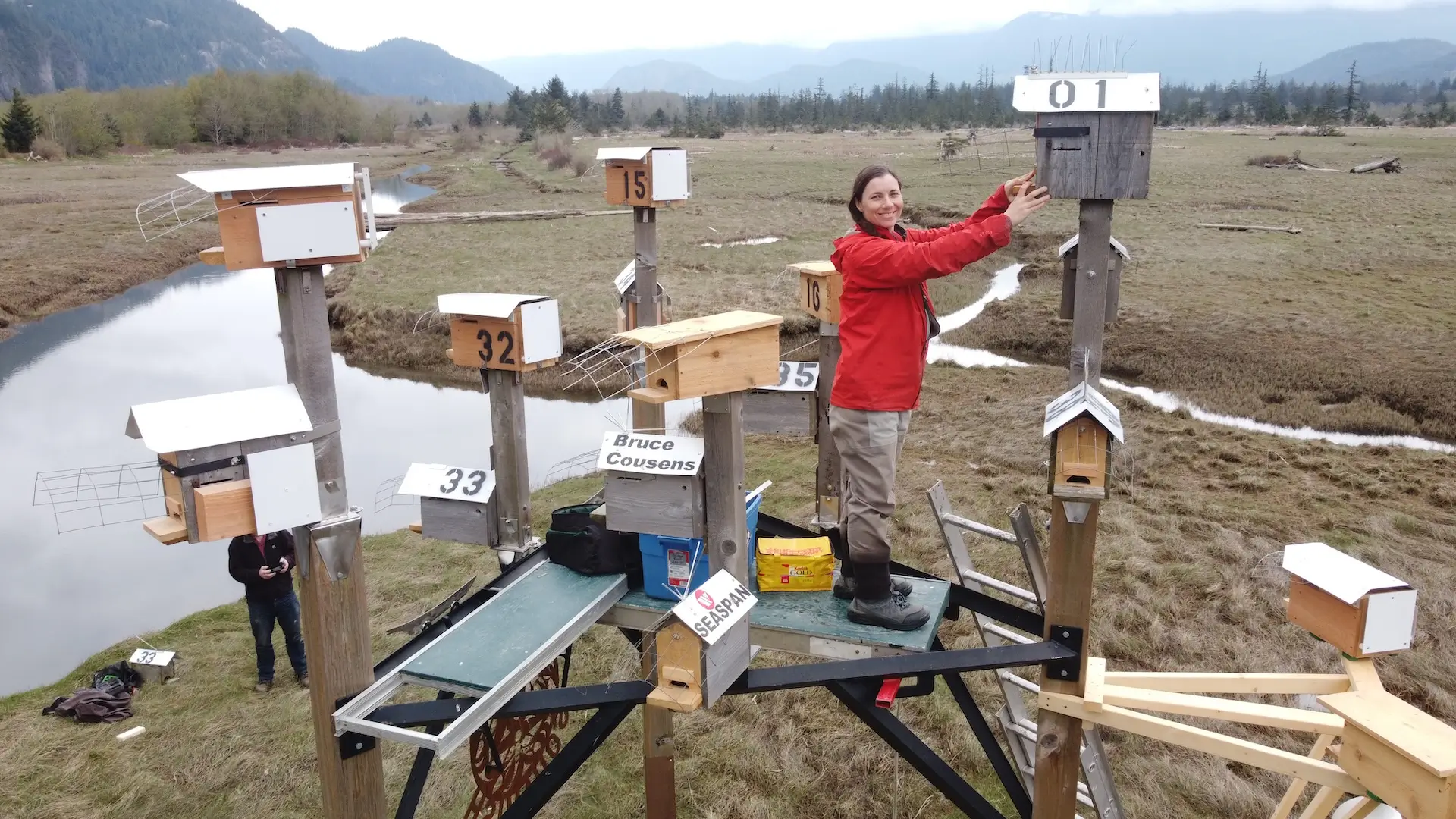
Our Purple Martin Recovery Program began in 2015 in collaboration with the Squamish River Watershed Society (SRWS). Since 2016, SES has led the program with continued support from partners and volunteers. In 2017, SES launched the Biodiversity Squamish Project to compile and curate species records within the Átl'ka7tsem/Howe Sound region using the iNaturalist platform. We also took over responsibility for the Brackendale Winter Eagle Count, to ensure the continuation of this long-standing community event and related data set.

In 2019 we launched a Western Toad Monitoring Program in partnership with BC Parks to track toad populations and guide conservation efforts at vulnerable breeding sites in Alice Lake Provincial Park.

2020-2025 A Major Project and a Name Change

SES became a registered charity in 2020 with a mandate to advance research on the natural history and biodiversity of the Squamish Valley and Howe Sound, share this knowledge through education and outreach, and undertake related stewardship activities. In 2021, the Átl'ka7tsem/Howe Sound area was designated a global UNESCO Biosphere Region. That following year, SES launched our Wildlife Connectivity Project to better understand shifting ecosystem health and support land managers by identifying corridors linking high-value habitats and protected areas across the Sea-to-Sky region.

In 2025, we began using Nature Squamish as our working name to align with other BC Nature clubs and strengthen our connection to the broader conservation community.

2026- Continuing Our Mission

Our work continues to advance the goals and objectives of our society. In 2026 we launched EcoScapes, an online learning hub and map portal, to share the resources and tools developed by our Wildlife Connectivity Project. We are working with local and regional partners to explore how these tools can support land managers in conserving connectivity networks and help individuals reduce their impacts.

A new Bird Count Portal collates our more than 20 years of bird count data and allows users to view the data in a variety of ways. New programs aim to raise awareness, engage the community, and support policy changes to make our urban environment more pollinator and bird friendly.

    Governance

    Nature Squamish is an incorporated non-profit society in British Columbia and a registered charity. Our legal name is Squamish Environmental Conservation Society but for day-to-day activities we use the shorter, more approachable name, Nature Squamish.

    Our board of directors oversees our activities, ensuring that they comply with our policies, bylaws and charitable purposes.

    We are affiliated with BC Nature, a federation of natural history clubs and organizations throughout BC.

    Constitution
    Bylaws
    2025 Annual Report

    Help take care of the land so the land will take care of us