
May 11, 2016
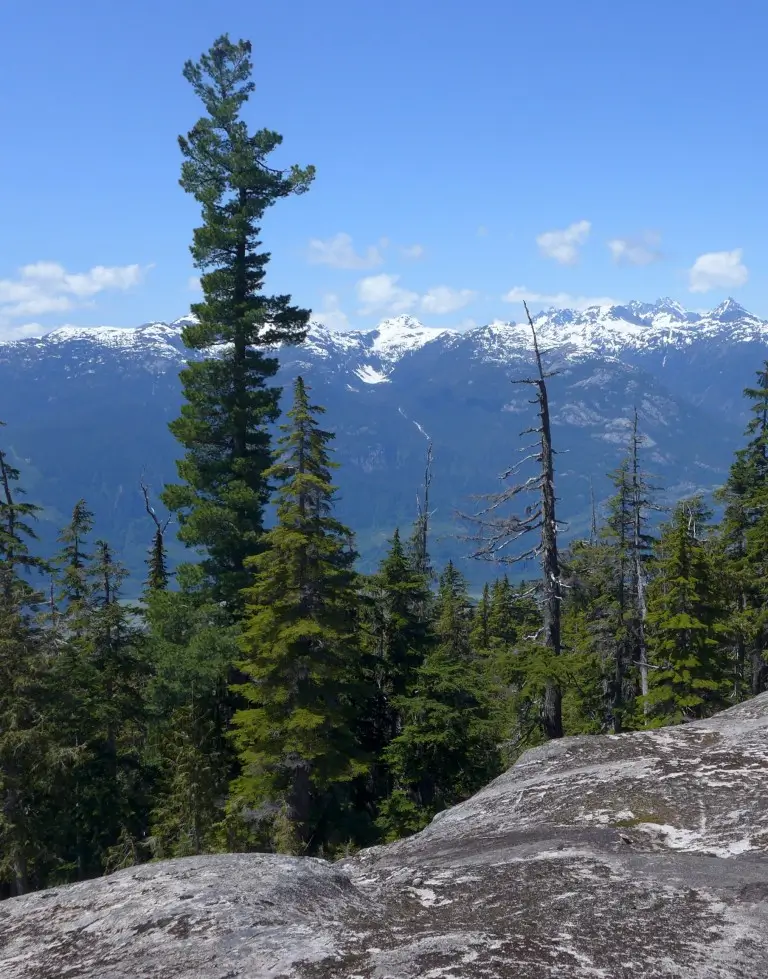
Our recent post on Red-flowering Currant mentioned that it is a known host for White Pine Blister Rust. This inspired our member Judith Holm to share her recent observations on the beautiful Western White Pines she has found in the area above the Sea to Sky Gondola. While there is some evidence there of trees with the disease, most are healthy and there is one surprisingly large individual.
This Western White Pine on Habrich Ridge towers above its neighbours. Its circumference measures 2.59 m, large but not record breaking. Around and Sky Gondola is an unusually wonderful display of healthy, beautiful Western White Pines!
White Pine Blister Rust Hosts and Life-Cycle
Any of the pine species with 5 needles per bundle can be susceptible to White Pine Bliser Rust (Cronartium ribicola). I have photographed evidence of this rust on the Pine along the Panorama Trail and the logging road access to Habrich Ridge and gondola staff first made me aware of the infected pine near one end of the suspension bridge. However, it is my impression that the Western White Pines above the Sea to Sky Gondola are so far remarkably healthy. Pines grow quickly but are susceptible to many diseases. That there are so many Western White Pines Pines in good health here is really special.
Cronartium ribicola is presently the name for the rust pathogen found on both our Squamish Western White Pines and plants in the currant and gooseberry (Ribes) family. Ribicola means “living on Ribes”. In addition, there is now evidence that White Pine Blister Rust has five distinct spore stages and requires a back-and-forth between the two hosts in order to complete its life cycle. Reports are in agreement that this disease does not spread from pine to pine.
The process is so complicated that I am utterly amazed that it actually works! Try googling Cronartium ribicola and you will find in the literature many attempts to express this complexity with pictorial diagrams.
What May Be Helping to Protect Western White Pines Above the Sea to Sky Gondola?
Here they are growing in a natural mixed forest, not commercially planted. Research is showing that although the spores can travel a great distance from the Western White Pines – almost 500 km – the currant species does seem to need to grow relatively nearby to act as a host. “Because of the delicacy of basidiospores (on Ribes) and their need for good conditions, successful dispersal distances are generally about 300 meters and at most 3 to 4 kilometers.”*
Red-flowering Currant (Ribes sanguineum), native but also horticulturally planted, and black gooseberry (Ribes lacustre) are common in Squamish but so far I have not found them growing at mid-elevations above the Gondola. Certainly Ribes are not obviously associated with Western White Pines above the Gondola, the way they can be in other areas. The Gondola folk were most cooperative in quickly removing the Red-flowering Currants they had planted at the top so that the abundant flowers did not have time to set seed and potentially establish the species. The Red-flowering Currants planted at the base of the Gondola did not flower in 2015 but they have this year (2016), so I’m curious to see if many fruit set. Their leaves are healthy and the plants are otherwise such a beautiful choice.
Should Cronartium spores float down from the Western White Pines (at higher elevations) and infect these Currants, it may be difficult for the spores to cause problems because of the elevation difference and distances involved. This is a complex matter and at present I think it is best to simply observe. Two genera of the Broomrape (Orobanchaceae) family, Paintbrush (Castilleja) and Lousewort (Pedicularis), are also co-hosts for White Pine Blister Rust. I have not yet found any in the areas I have accessed above the Gondola, which in addition to the main trails includes going up to the base of Co-Pilot from both the Sky Pilot and Skyline Trails and up Robin’s Connector onto Habrich Ridge, via Yuko’s Ponds.
I think that the good air circulation on the ridges and slopes is also helping. However, the topography of the Wonderland Lake area is more conducive to the pooling of damp air. Various reports show that, in general, upper slopes and ridges are less conducive to blister rust infections than benches and valleys, where cool, moist air carrying spores settles into depressions.
If anyone finds plants of the currant and gooseberry (Ribes) or broom-rape (Orobanchaceae) family around and above the Sea to Sea Gondola, or Western White Pines with symptoms of white pine blister rust, I would be grateful if you would let me know, at holm@telus.net. Photographs, location (UTM’s or approximate Lat/Long & elevation from Google Earth) and habitat notes all help make your data useful.
Do you too find that Nature’s complexity and beauty fills you with awe and appreciation,
many more questions than answers?
* References:
- http://www.forestpathology.org/dis_wpbr.html
- Dr. Richard Hamelin, Faculty of Forestry, UBC, by personal communication
Banner photo compilation, using images by Peter Stevens and Rogów Arboretum via Wikimedia. Inset image by Judith Holm.